

Product · Prototype
Change Impact, with an inspectable basis
A product surface for comparing controlled revisions, tracing bounded downstream consequences, and recording accountable review without replacing the system of record.
Inspectable claims. Declared scope. Human accountability.
Trigger and inputs
Begin with an explicit approved old/new source-version pair and a declared portfolio boundary. The prototype supports machine-readable PDF, DOCX, XLSX, and UTF-8 TXT inputs in the locally qualified workflow; OCR and image-only documents are outside the claim.
EvidView records received source versions and immutable snapshots before analysis. First-contact website forms do not accept controlled documents.
Analysis
Document structure narrows the changed regions. Typed semantic records bind populated fields to exact source evidence. Structural and semantic change records keep exact before-and-after excerpts and an explicit review state.
Dependency candidates may come from exact references, structural matches, entities, lexical retrieval, or vector retrieval. Their origin, evidence, method, version, state, and coverage signals remain available for inspection.
Text, meaning, and impact are different records
Move through three levels. Each level keeps its own evidence basis and does not silently become the next.
- Changed text exact evidence
- Semantic Delta reviewed interpretation
- Downstream impact dependency-based inference
Level 1 · exact evidence
Text diff
Version 4.1The Quality Investigator
mayinitiate the investigation within30 calendar daysof intake.
Version 4.2The Quality Investigator must initiate the investigation within 15 calendar days of intake.
This establishes: which exact source characters differ. It does not establish normalized meaning or downstream impact.
Level 2 · reviewed interpretation
Semantic Delta · SD-SYN-001
- Actor
- Quality Investigator
- Action
- initiate investigation
- Modality
OPTIONAL→ MANDATORY- Timing
WITHIN 30 CALENDAR DAYS→ WITHIN 15 CALENDAR DAYS
This establishes: the normalized meaning accepted for this synthetic narrative. It does not establish which downstream objects depend on that meaning.
Level 3 · dependency-based inference
Downstream impact
| Object | Relationship state | Bounded outcome |
|---|---|---|
| WI-08 | confirmed | potentially affected |
| CL-04 | confirmed | potentially affected |
| TR-22 | inferred — review required | review required |
| FRM-11 | evaluated | no relevant impact found within evaluated scope |
| SOP-21 | blocked | not evaluated |
This establishes: outcomes supported by eligible paths inside the declared evaluation. Text comparison alone did not produce these findings.
Declared boundary: A result applies only to this declared synthetic portfolio, frozen graph, applicability policy, and evaluation budget.
Inspect the path, not just the outcome
Select a target to inspect its node, relationship basis, evidence, lifecycle state, version, and bounded impact reason.
Choose a target
Target node · WI-08
Investigation Work Instruction
- Source evidenceQMS-SOP-014 v4.2
- Semantic DeltaSD-SYN-001
- Relationshipreferences and restates
- TargetWI-08
- Object
- WI-08 · Investigation Work Instruction
- Type
- Controlled work instruction
- State
- confirmed
- Reason
- The work instruction repeats both changed fields.
- Source
- QMS-SOP-014, Section 6.2, paragraph 2
- Evidence
- Section 2 cites QMS-SOP-014; section 4.1 repeats the 30-day initiation window.
- Relationship
- references and restates
- Origin
- exact reference plus structural match
- Method
- deterministic reference rule v1
- Lifecycle state
- confirmed
- Graph version
- GRAPH-SYN-2026-09-15-01
- Comparison
- CMP-SYN-2026-09-15-01
Target node · CL-04
Investigation Intake Checklist
- Source evidenceQMS-SOP-014 v4.2
- Semantic DeltaSD-SYN-001
- Relationshipimplements
- TargetCL-04
- Object
- CL-04 · Investigation Intake Checklist
- Type
- Controlled checklist
- State
- confirmed
- Reason
- The acceptance criterion contains the previous deadline.
- Source
- QMS-SOP-014, Section 6.2, paragraph 2
- Evidence
- Checklist item 7 asks whether initiation occurred within 30 calendar days.
- Relationship
- implements
- Origin
- field-to-claim match
- Method
- policy rule v3
- Lifecycle state
- confirmed
- Graph version
- GRAPH-SYN-2026-09-15-01
- Comparison
- CMP-SYN-2026-09-15-01
Target node · TR-22
Investigator Refresher Training
- Source evidenceQMS-SOP-014 v4.2
- Semantic DeltaSD-SYN-001
- Relationshiptrains
- TargetTR-22
- Object
- TR-22 · Investigator Refresher Training
- Type
- Training module
- State
- inferred — review required
- Reason
- The content is semantically related, but the relationship is not yet confirmed.
- Source
- QMS-SOP-014, Section 6.2, paragraph 2
- Evidence
- Module 3 teaches investigation initiation timing but does not cite the SOP identifier.
- Relationship
- trains
- Origin
- semantic candidate
- Method
- bounded candidate classifier v2
- Lifecycle state
- inferred — review required
- Graph version
- GRAPH-SYN-2026-09-15-01
- Comparison
- CMP-SYN-2026-09-15-01
Declared boundary: A result applies only to this declared synthetic portfolio, frozen graph, applicability policy, and evaluation budget.
Review
Named reviewers can confirm, correct, reject, or leave supported records unresolved. Decisions bind to exact versions and append to history. A score is not presented as probability of truth.
Ambiguous evidence, unsupported inputs, stale versions, and exhausted budgets remain visible and may block a conclusion.
A real prototype interface, with a synthetic boundary
This capture is rendered from the authenticated M0–M4 product interface at source revision 22dc5907f9164c0bf6c015a51b7077be83a4723e. It shows the impact queue, confirmed source change, graph edge, exact edge evidence, and review controls in one inspectable state.
All visible records are synthetic. The capture demonstrates the locally qualified Prototype interface only; it is not evidence of public self-service, production availability, customer use, benchmark performance, or a compliance outcome.
- Status: Real prototype interface · synthetic data
- Product version: 0.1.0 · M0–M4 local build
- Review: renew the capture when the bound product source or public status changes
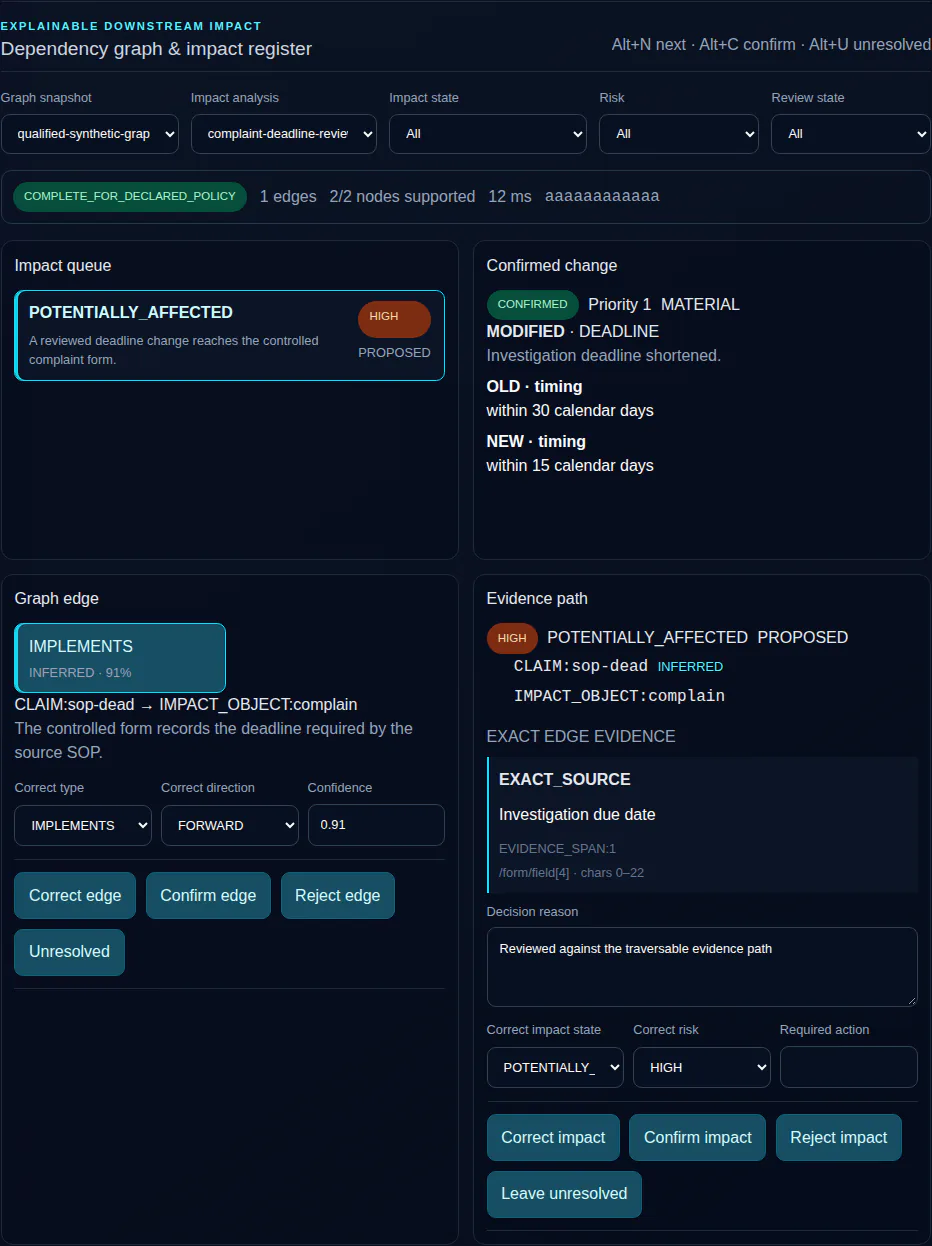
Impact review, source revision 22dc590
Locally qualified M0–M4 interface. No public self-service, production, customer, or benchmark claim.
Outputs and boundaries
The current prototype basis supports Semantic Delta records, dependency and impact review, explicit uncertainty, and bounded unaffected results. A positive impact retains a reconstructable evidence path.
No relevant impact found means no eligible path was found inside one declared frozen graph, evaluated universe, applicability policy, and traversal budget. It does not cover unregistered, excluded, failed, or unknown dependencies.
Inspect the path, not just the outcome
Select a target to inspect its node, relationship basis, evidence, lifecycle state, version, and bounded impact reason.
Choose a target
Target node · WI-08
Investigation Work Instruction
- Source evidenceQMS-SOP-014 v4.2
- Semantic DeltaSD-SYN-001
- Relationshipreferences and restates
- TargetWI-08
- Object
- WI-08 · Investigation Work Instruction
- Type
- Controlled work instruction
- State
- confirmed
- Reason
- The work instruction repeats both changed fields.
- Source
- QMS-SOP-014, Section 6.2, paragraph 2
- Evidence
- Section 2 cites QMS-SOP-014; section 4.1 repeats the 30-day initiation window.
- Relationship
- references and restates
- Origin
- exact reference plus structural match
- Method
- deterministic reference rule v1
- Lifecycle state
- confirmed
- Graph version
- GRAPH-SYN-2026-09-15-01
- Comparison
- CMP-SYN-2026-09-15-01
Target node · CL-04
Investigation Intake Checklist
- Source evidenceQMS-SOP-014 v4.2
- Semantic DeltaSD-SYN-001
- Relationshipimplements
- TargetCL-04
- Object
- CL-04 · Investigation Intake Checklist
- Type
- Controlled checklist
- State
- confirmed
- Reason
- The acceptance criterion contains the previous deadline.
- Source
- QMS-SOP-014, Section 6.2, paragraph 2
- Evidence
- Checklist item 7 asks whether initiation occurred within 30 calendar days.
- Relationship
- implements
- Origin
- field-to-claim match
- Method
- policy rule v3
- Lifecycle state
- confirmed
- Graph version
- GRAPH-SYN-2026-09-15-01
- Comparison
- CMP-SYN-2026-09-15-01
Target node · TR-22
Investigator Refresher Training
- Source evidenceQMS-SOP-014 v4.2
- Semantic DeltaSD-SYN-001
- Relationshiptrains
- TargetTR-22
- Object
- TR-22 · Investigator Refresher Training
- Type
- Training module
- State
- inferred — review required
- Reason
- The content is semantically related, but the relationship is not yet confirmed.
- Source
- QMS-SOP-014, Section 6.2, paragraph 2
- Evidence
- Module 3 teaches investigation initiation timing but does not cite the SOP identifier.
- Relationship
- trains
- Origin
- semantic candidate
- Method
- bounded candidate classifier v2
- Lifecycle state
- inferred — review required
- Graph version
- GRAPH-SYN-2026-09-15-01
- Comparison
- CMP-SYN-2026-09-15-01
Declared boundary: A result applies only to this declared synthetic portfolio, frozen graph, applicability policy, and evaluation budget.
- Semantic Delta
- Meaning change with exact old/new evidence.
- Impact Register
- Objects, paths, risks, owners, and review states.
- Ambiguity Queue
- Competing evidence and unresolved meaning.
- Unaffected Scope
- Bounded negatives inside the declared evaluation.
- Evidence Package
- Research direction Decisions, action evidence, approvals, and closure.
Closure is a gate, not a generated paragraph
The intended workflow connects accepted impacts to actions, implementation evidence, exceptions, approvals, and a frozen release basis. Those M6–M8 closure capabilities are research direction, not part of the current M0–M4 prototype claim.
A future closure state must require resolved blocking findings, completed or explicitly excepted actions, checked evidence, required approvals, and an immutable basis.
Analysis is not closure
This synthetic target-workflow sequence shows why an impact result remains open until decisions, actions, evidence, scope exceptions, approvals, and the release basis satisfy explicit gates.
Negative example
Analysis complete; change still open
2 complete · 3 blocked · 2 waiting
- CompleteAnalysis complete
Bounded findings and exclusions recorded.
- CompleteBlocking decisions
2 / 2 decisions resolved.
- BlockedRequired actions
2 / 3 actions dispositioned; TR-22 remains open.
- BlockedImplementation evidence
Training completion evidence is missing.
- BlockedCoverage exception
SOP-21 is stale and neither evaluated nor accepted as an exception.
- WaitingRequired approvals
Approval cannot precede resolved evidence and scope gates.
- WaitingRelease basis
The comparison and evidence package are not frozen for closure.
Blocking reason: training evidence is missing and SOP-21 remains outside the evaluated basis.
Illustrative final state
Every declared gate is satisfied
7 / 7 gates complete
- CompleteAnalysis complete
Bounded findings and exclusions recorded.
- CompleteBlocking decisions
2 / 2 decisions resolved.
- CompleteRequired actions
3 / 3 actions completed, waived, or accepted as exceptions.
- CompleteImplementation evidence
Evidence is attached to each exact action and version.
- CompleteCoverage exception
SOP-21 is evaluated or explicitly accepted as a scoped exception.
- CompleteRequired approvals
Accountable approval records are present.
- CompleteRelease basis
Comparison, graph, decisions, actions, evidence, and limitations are frozen.
Boundary: Closed describes this synthetic target-workflow narrative only, not current product capability or a customer result.
Designed to sit beside your controlled systems
EvidView is a change-assurance layer beside QMS, DMS, GRC, ALM, requirements, and workflow systems. It does not replace their document-control, approval, or system-of-record roles, and no specific integration is implied.
Systems of record
QMS · DMS · GRC · ALM · requirements · workflow
Controlled content and approvals remain here.EvidView
Scoped versions → governed findings
No implemented connector is implied.Next step